Outlines of Kii-fudoki-no-oka Museum
Contents Here
Facilities
(updated on Feb. 14, 2025)
-
The Name "Kii-fudoki-no-oka"
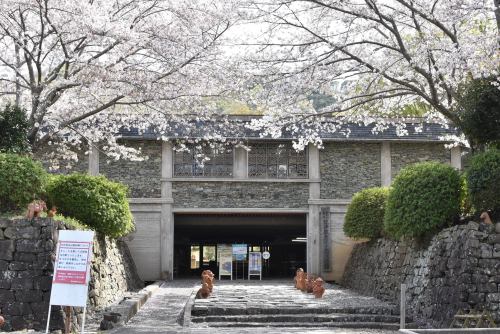
- A name plate in English at the entrance "Wakayama Prefectural Kii-fudoki-no-oka Museum of Archaeology and Folklore" is clear and easy to understand what it is.
- "Kii" is a traditional place name for the present Wakayama area since the Nara Period.
- "Fudoki 風土記", which literally means "wind, soil, record," was a name for official books describing regional climate, culture, and others. The Fudoki Books was compiled in the Nara Period.
- The last part of the name "no-oka" means "hill of" in Japanese.
- As the result, the total name Kii-fudoki-no-oka roughly means "Hill of Fudoki (a book of regional history and culture) in Kii (present Wakayama). "
-
The Foundation of Kii-fudoki-no-oka Museum
- Kii-fudoki-no-oka was founded in order to preserve and take advantage of Iwase-senzuka Kofun Cluster in 1971.
- In 1960s, during the early high economic growth period after World War II, even important historical sites were being destroyed due to road building or house development.
- The national government employed new measures to conserve them. Opening museums of history named "Fudoki-no-oka" was one of them.
- Kii-fudoki-no-oka is one of 16 Fudoki-no-oka museums in Japan.
- Konosuke Matsushita, a famous businessperson from Wakayama, gave a substantial donation to the prefectural government as a part of the cost of the construction. A board at the main entrance says, "Matsushita Memorial Museum."
-
The Main Building
- The property is adjacent to Iwase-senzuka Kofun Tumuli Cluster.
- The first floor has a space for activities, a relocated burial stone chamber and various displays.
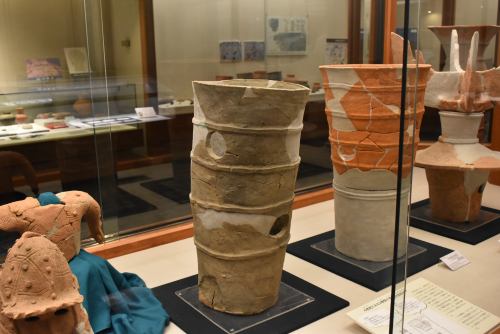
- The second floor has exhibition rooms for haniwa clay figures including National Important Cultural Assets, archaeological relics and folk articles both of which are from Wakayama Prefecture.
- A part of a very big trunk of a camphor tree which grew around 1,500 yeas ago in the Kofun period when burial mounds at Iwase-senzuka were built is displayed in front the of the main building.
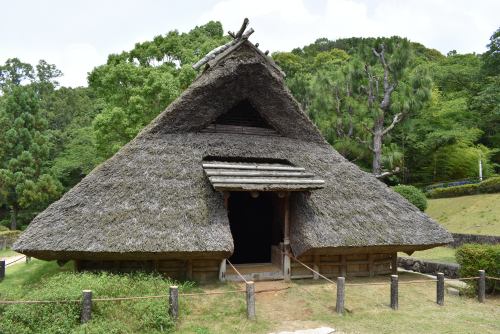
- An experimental rice paddy, a newly built pit dwelling with a inside cooking stove, relocated archaeological sites and others are by the main building.
- The main building itself is designated as a Registered Tangible Cultural Property by the national government.
- Currently, a museum annex and repositories, which are expected to be open in fall of 2028, are under construction.
You check the opening hours and so on at the official website Kii-fudoki-no-oka Museum.
Permanent Exhibition
Items on permanent display are largely classified into three groups. They are haniwa clay figures, historical relics (a regular history) and folk articles. (updated on Feb. 14, 2025)
-
About Haniwa Clay Figures
- The Japanese word "haniwa" originally meant "clay cylinder" or "circle of clay."
- Haniwa are large hollow earthenware objects. Those unglazed cylinders, pots, and figures were arranged on top of kofun in the Kofun period.
- When keyhole-shaped kofun tumuli began to be built, haniwa clay figures also started to be made.
- The first typical haniwa were cylindrical ones and pot-shaped ones.
- Then in the 4th C, house-shaped ones, tool-shaped ones and animal (bird)-shaped ones began to be made.
- After that, in the 5th C, person-shaped ones appeared.
-
Exhibits of haniwas unearthed in Iwase-senzuka Kofun Cluster
- From 2003 through 2005, numerous fragments of haniwa were unearthed at Dainichi-yama No. 35 kofun tumulus.
- The excavated haniwa were restored and many of them were discovered to be unique to Iwase-senzuka.
- Those highly distinctive ones are designated as National Important Cultural Assets of Japan.
- Dainichi-yama No. 35 is thought to have been constructed in the first half of the 6th century.
- You can see photographs of haniwa of Iwase-senzuka at Unique Haniwas of Dainichi-yama No. 35 in this website.
-
Exhibition of Historical Relics From Wakayama Prefecture
- The exhibits are arranged in chronological order from the Old Stone Age to the period when Buddhist temples started to exist in Japan.
- You can see the photos at Historical Relics in this website.
-
Exhibition of Folk Articles
- Exhibits of folk articles collected in Wakayama Prefecture are displayed.
- The items on display are periodically replaced one after another.
- You can see the photos at Folk Articles in this website.
Relocated Old Folk Houses
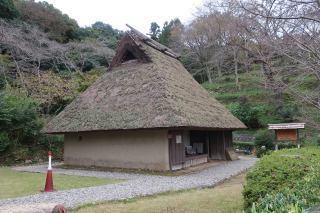
The four wooden houses were originally situated in different places in Wakayama Prefecture. They were relocated to Kii-fudoki-no-oka when the museum was founded in 1971. All of them were constructed in the Edo period. (updated on Feb. 14, 2025)
-
Former House of the Yanagawa Family
- Relocated from Kuroe, Kainan City.
- A merchant house built in 1807.
-
Former House of the Taniyama Family
- Relocated from Shiotsu, Kainan City.
- A fisherman (also involved in marine transport) house built in 1749.
-
Former House of the Tanimura Family
- Relocated from Arida-gawa Town.
- A peasant house built in the second half of the 118th C.
-
Former House of the Kobayakawa Family
- Relocated from the Hidaka-gawa Town.
- A peasant house built in the second half of the 118th C.
You can see the photos at Relocated Old Folk Houses in this website.