Outlines of Iwase-senzuka
Contents Here
Keywords
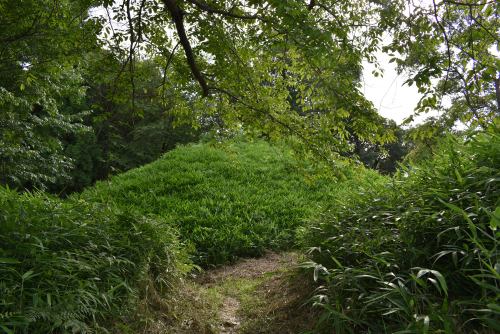
-
"Special Historic Sites"
- Iwase-senzuka is one of National Special Historic Sites of Japan.
- According to Agency for Cultural Affairs of the national government, 1,895 sites are currently designated as Historic Sites, and among Historic Sites, particularly important 63 sites are classified as Special Historic Sites.
- The Golden Pavilion and Himeji Castle, for example, are also in the same category.
-
"900"
- 900 is the number of kofun burials mounds located inside the area of Iwase-senzuka Kofun Cluster.
- Most people get surprised to see a lot of small-seized kofun built close together in each small section of Iwase-senzuka.
- They have a good reason to be amazed as long as they think a huge kofun like Daisen-ryo Kofun in Sakai City is a typical one.
- The number of kofun in Iwase-senzuka is one of the largest among kofun clusters in Japan.
- In addition, and the total might increase in the future. Burial mounds could be newly detected there. Actually, four burial stone chambers were recently found near the museum in 2022.
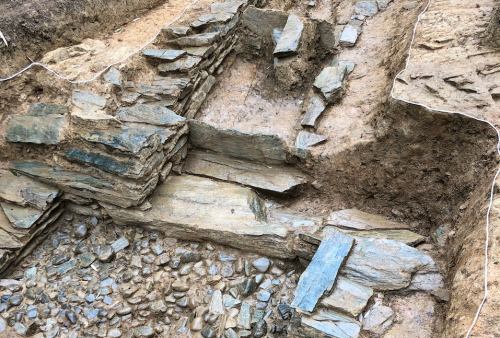
-
"The 6th Century"
- Many of clustered kofun in Japan appeared in the late Kofun Period, roughly in the 6th century. Iwase-senzuka is one of them.
- Some Iwase-senzuka kofun appeared in and after the late 4th century. The large majority, however, were constructed in the 6th century.
- During the early and mid-Kofun Period in the mid 3rd through around the end of the 5th C, only the highest-ranking people had their own kofun. Then, in the late Kofun Period in the 6th C, those who had never been permitted to possess their own kofun before commenced to build their own kofun.
- The social circumstances must have changed at the beginning of the late Kofun Period in the early 6th century.
-
"Iwase-type Horizontal Burial Stone Chambers"
- Unique structure made of distinctive stones characterizes burial facilities in Iwase-senzuka.
- The manner called "Iwase-type" differs in its chamber shape, material, the construction method, and others from that of neighboring area like Osaka or Nara.
- Interestingly, the method is said to have been employed only in the northern part of Wakayama Prefecture.
Essentials
The next are the some of the basics of Iwase-senzuka Kofun Tumuli Cluster. (updated on Feb. 16, 2025)
-
Tomb Owners
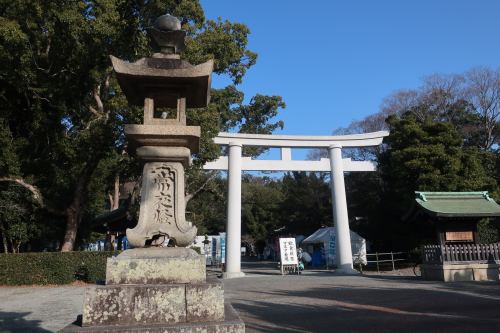
- Iwase-senzuka, of which kofun burial mounds were built in the Kofun period, is thought to have been closely related with the Kii family who dominated the area around the mouth of the Kinokawa River in those days.
- Members of the Kii family have taken over the position of the chief priest of Nichizen-gu Shinto Shrine since ancient times.
- The tomb owners of kofun in Iwase-sezuka are thought to have been either the Kii family members or those who supported the family.
-
Name
- The name seems to have originally meant "a thousand of mounds in a village called Iwase."
- Currently, it is often referred to as Iwase-senzuka for short.
-
Characteristics
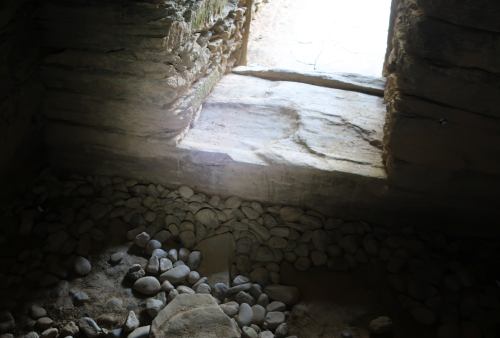
- The kofun groups is widely known for its characteristic style of the tomb chambers called "Iwase-type Horizontal Burial Stone" and its unique haniwa clay figures.
- It has around 900 burial mounds in the whole area and the number is one of the largest in Japan.
- In the cluster, the number of keyhole-shaped kofun tumuli is 28 and that of square ones is 20. All the rest are circular kofun tumuli. (counted by the website owner)
- A part of the whole area is designated as National Special Historic Site. Around 500 kofun tumuli are situated in the appointed zone. (Updating: Feb. 13, 2025)
-
Sections in the Area of Iwase-senzuka
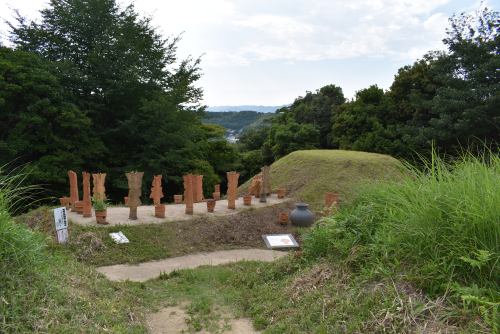
- The large area of Iwase-senzuka is usually divided into 10 sections: Hanayama, Otani-yama, Dainichi-yama, Iwase Mae-yama B, Iwase Mae-yama A, Wasa, Imbe Mae-yama, Imbe, Terauchi and Sando.
- The area designated as Special Historic Sites includes Otani-yama, Dainichi-yama, Iwase Maeyama B, Iwase Mae-yama A and a part of Wasa (Tenno-zuka Kofun).
-
The Period When the kofun were Built
- As the whole area, the kofun tumuli were built between around the end of the 4th century and the beginning of the 7th century.
- Periods when kofun tumuli were intensively built are different from section to section.
- For instance, in the section of Mae-yama A, they were built from the mid 5th century to the end of the 6th century.
- Also, for example, in the section of Dainichi-yama, they were built around the first half and the middle of the 6th century.
-
Total lengths and estimated construction periods of the representative keyhole-shaped kofun tumuli are as follows. (reference: Wakayama Prefecture 2025, Tanno and Yoneda, 2018)
- Hanayama No. 8 (52 m, the end of the 4th C through the beginning of the 5th C)
- Ohtani-yama No. 22 (88 m, the 1st half of the 6th C)
- Immbe Hachiman-yama Kofun (88 m, the 1st half through the middle of the 6th C)
- Dainichi-yama No. 35 (73m, the 1st half through the middle of the 6th C)
- Tenno-zuka Kofun (88 m, the middle of the 6th C)
- Shogun-zuka Kofun (42.5 m, the middle of the 6th C)
Iwase-type Horizontal Burial Stone Chamber
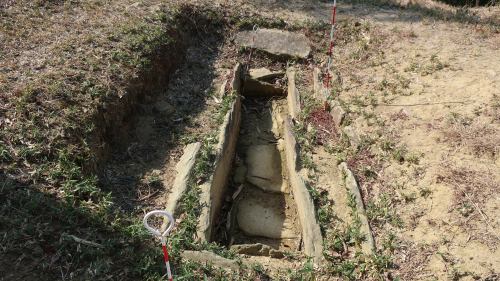
Style of horizontal burial stone chamber seen at Iwase-senzuka is quite different from that of Osaka or Nara and the difference lies in the building materials, the structure and so on. (updated on Feb. 16, 2025)
-
Typical Four Styles of Burial Facilities
- Wooden Coffins Coated with Clay
- Box-style Stone Coffins (This style did not have a room)
- Vertical Burial Stone Chambers (Space for the dead became large enough to be called "chamber". Only one person was enshrined there. The style was popular in the 5th century.)
- Horizontal Burial Stone Chamber (A horizontal passage was attached to the burial chamber. It became possible to enshrine plural people when necessary. The chamber was closed with a door-like rock. The style appeared in the northern part of Kyushu in the 5th century and grew popular in other places in the 6th century.)
-
Building Stone Used at Iwase-senzuka
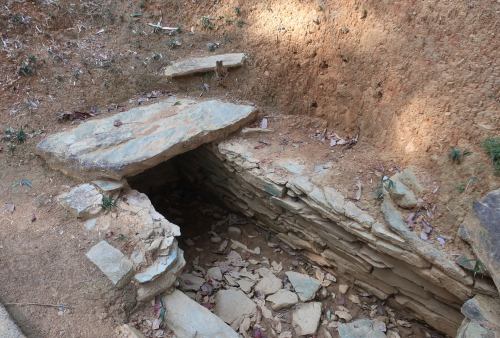
- The building material used at Iwase-senzuka was exclusively crystalline schist.
- It is a kind of metamorphic rock which can be split into thin layers.
- The rough brick-like thin plates of crystalline schist are laid by corbeling to form two slightly slanted interior walls.
- It is easy to find out outcrops of the crystalline schist.
-
Stone Beams and Stone Shelves
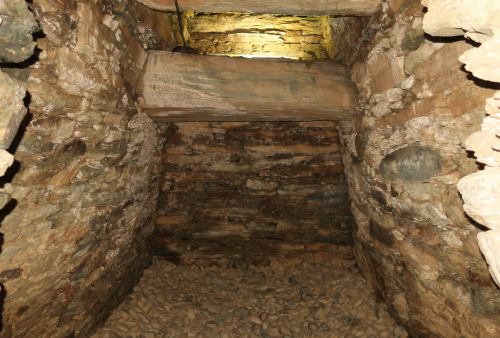
- The horizontal rock components which look like a beam or a shelf also attract visitors' attention.
- The stone beams and stone shelves inside the burial chambers are thought to have been installed to strengthen the structure of the chambers.
- Actually, almost all the stone rooms have kept their original shapes for around 1,500 years.
-
No Coffins
- Coffins are found in horizontal burial stone chambers of the Kinai area including Nara and Osaka.
- But no parts of coffins have been identified in Iwase-senzuka.
- It is interesting to know that stone coffins were not seen inside some stone chambers in the northern part of Kyushu, either.
- Relationships between the Ki family in Wakayama and Northern Kyushu might have existed in the Kofun Period.
-
Burial Stone Chambers Which Visitors Are Allowed to Enter
- Currently, the number of the stone burial chambers visitors can go in at Iwase-senzuka is seven.
- They are always open to visitors for free.
- Six of them are located in a section called Iwase Maeyama A, which is the closest to the museum building.